Featured...

Click on the image for more information... Click on the image for more information... Click on the image for more information... Click on the image for more information... Click on the image for more information... Click on the image for more information...
Showing posts with label historical-fiction. Show all posts

Sunday, March 23, 2014

The Treasure of Kafur by Aroon Raman


Blurb (from the jacket):


‘The fate of an Empire trembles in the balance…’

Hindustan, 1580 AD. The Mughal Emperor Akbar is at the height of his power, seemingly invincible. But twenty years of war have earned him many enemies, and rebellion is brewing, led by Asaf Baig, the tyrannical ruler of Khandesh. Baig has stumbled upon the knowledge that the fabulous lost treasure of Malik Kafur, that will guarantee victory to Akbar’s enemies, is known to an old woman called Ambu.

Baig Kidnaps Ambu to wrest the knowledge of the treasure from her; but her twenty-year-old grandson, Dattatreya, escapes and flees across Hindustan to enlist the help of the one person who has the most reason to stop Baig – the Mughal Emperor himself.

Staying one step ahead of capture and death, Datta is swept up in a world of kings and warrior princesses, of uncommon friendships and an implacable evil; and a desperate race against time to save his grandmother – and the Empire.

Aroon Raman, national bestselling author of The Shadow Throne now brings us a riveting saga of action and adventure set in Mughal India.

Friday, February 28, 2014

The Mountain of Light by Indu Sundaresan


Foreword:


It was during the release of this book, it hadn't yet hit the market. There was a huge campaign of marketing going on about this book. Almost every book-reviewing site I knew was marketing/advertising about this book.

In fact, the author was hailed like some very well known author, when it was the first time I had heard of this author. I didn't even hear of her most acclaimed work, The Taj Trilogy - consisting of The Twentieth Wife, The Feast of Roses, Shadow Princess.

Having very high expectations, I liked the author's FaceBook page.

After the book hit the market, I saw a post by the author, herself, announcing a huge giveaway to readers in exchange to a book-review. Well, I dropped in my e-mail ID.

The following day, I was contacted for the shipping details, which I provided. A month or two passed since then. I even forgot that a book like this even got published. All of a sudden, there was a courier at my doorstep. I was wondering who sent the book, as I had stopped accepting books for reviewing during that time.

To my surprise, it was this book. Then I left the book as it is for a very long time, until day before yesterday...

Thursday, February 6, 2014

The God of Small Things by Arundhati Roy


Foreword:


Clearly, I had chosen this book for the reason that it had won Man Booker (Back when this book won it, it was called Booker Prize). And also, due to the provocative probing of Srinivas, the other author of the blog.

He rated the book all five stars and knowing him pretty well for quite a long time, I know that he doesn't easily give a book five stars. There must be something special about this book for him to do that.

Though, the title and the proud declaration - WINNER OF THE BOOKER PRIZE - were encouraging, I had this feeling laziness ever since I started reading it. Maybe it is due to long gap during which I hadn't read a word, during my vacay. Or maybe I am going through a phase of life, like 'Readers' Block'.

Whatever may be the reason, I finally completed this book, which more or less took more than 2 week - 16 days, to be precise. 

Hope you will enjoy the review as much as I did reading this book...

Blurb (from GoodReads):
"They all crossed into forbidden territory. They all tampered with the laws that lay down who should be loved and how. And how much." 

Friday, January 31, 2014

Untouchable by Mulk Raj Anand


Foreword:


In my spree of reading more Indian books than international authors, I have read a quite a wide array of books. Most of them were love stories. IITians. IIMs. Contemporary college romances. Some chic-lits. Then came intense stories and authors, like Amitav Ghosh, R. K. Narayan. With Narayan came Mulk Raj Anand.

A line in the author's introduction in this book goes like this,

"... he together with R. K. Narayan, Ahmed Ali and Raja Rao, was one of the first India-based writers in English to gain an international readership..."

I have read R. K. Narayan. I see him as my idol. I admire his work. I decided to try Mulk Raj Anand in the hope that he writes with the same intensity as Narayan.

Well, I am disappointed. They are no same authors. They way of fiction differ entirely from each other, save for one aspect. Only that they write about Indians. Even the societal class of which they describe in their story differ!

But it must be accepted that every author has his own way of writing and his own stories. No two author's work must be compared. Keeping that in mind, I move on to write the review to a book, whose type I have never encountered before. It was fresh. New to me. And refreshing.

Sunday, September 15, 2013

The Guardians of Karma by Mohan Vizhakat


Foreword:


Like many other books from Srishti, this book too was sent by Arup Bose.

When I first received this book (I received it like this) I was damn excited. The cover gives the impression of a sci-fi. And I am damn excited about sci-fis.

The Guardians of Karma. What a name? I had real high stakes before starting reading this book sometime around last weekend.

Plot (from Goodreads):


INTRIGUING MYTHOLOGICAL SF THRILLER BASED ON ANCIENT SHIVA PURANA

Prehistoric times beyond the mists of vedic India - the forgotten era of ‘first wave’ civilisations.

Around 10500 BCE, with sea levels much lower than they are today, and mainland continents still largely covered with ice, the primary centres of Indian civilisation were dominated by two highly advanced nation states – Dev Lok and Daityan Empire. Spiritually-inclined Devas lived in harmony with nature, whereas Daityas believed in brute force technologies for rapid prosperity and material gratification. Steady inundation of the tropical islands created a crisis, particularly for Daityas. To fuel their hunger for material resources, the aggressive Daityas proceeded to invade other nations.

Sunday, July 14, 2013

Manuscript Found in Accra by Paulo Coelho


Review:


It has been a long time since I have read a book of my choice. Courtesy my regularly fed to-be-read (tbr) list.

I always had a thing for Paulo Coelho's work, ever since I read his The Alchemist. It was my first read from him and it was exactly my type. Those were the days when I started reading. That book really mesmerized me. Well, let me stop it here or else I might slip into writing a review for The Alchemist.

After that, he has released his book Aleph, which I have bought and read and gave up in the middle. The Alchemist and Aleph were two different beings entirely. The fiction, the adventurous touch, they differed in every aspect possible. Most of all, the latter bored me, unlike the former one.

And then came this book, Manuscript Found in Accra. The title of the book, itself, has a mysterious stroke to it. I never would have bought the book if its not for the tempting offers and discounts the online book-selling portals provide you with. However, I bought this book long back and arranged in such a way that, whenever I lifted my head off my laptop screen, the front cover of this book soothed my eyes. I don't think I can come across a more enchanting cover design in the next 100 years!

Anyway, it hardly took a day for me to complete reading this book and write a review on it.

Plot (from the jacket):

'Only he who gives up is defeated.
Everyone else is victorious.'

After lying undiscovered for over 700 years, a manuscript holding the answers to a city's final questions is unearthed from a cave in Cairo.

Centuries before, on the eve of the invasion of Accra, the citizens gathered. A man stood before them and invited the people share their fears that he might offer hope and comfort.

His extraordinary insights on courage, solitude, loyalty and loss were transcribed and passed on.

A timeless and powerful exploration of personal growth, everyday wisdom and joy.

My view:
Cover design:
Like I have mentioned earlier, I don't think I would come across a better cover design in the next hundred years! The use of extreme shades and the textural picture on the background of the entire cover is just awesome. To top that, the golden letters and details in the design was just out of this world.

Let me try to depict you the awesomeness of the design...


The golden part of the entire cover design glisten when light is bestowed on it. A small heart-attack is triggered inside me, whenever I notice a minute damage to the cover of this book.

I so love the cover design of this book!!

Publishers:
Harper Collins. They are one of the largest publishing houses in the industry. When I say that I don't mean nationwide, but international industry. They have published many highly notable books. Their imprints make a huge list. If you read foreign - non-Indian - authors, you know these publishers. And that's it.

Language:
Well, I don't see that I could give much credit to the author about this aspect. Because I don't know that his words were exactly translated. In the same way, I can't blow the credit to the translator - by name, Margaret Jull Costa - since I don't know whether she had added her creativity to the language. Either way, the language used in the novel is just fabulous. It is simple and gripping. There is almost no, a couple of them at most, difficult words which I don't know the meaning of. It was amazing how use of such simple words could be so gripping. I learnt that it is not the complexity and the complicated use of vocabulary but the narration that counts. Hats off to you, Margaret Jull Costa...

Story and other aspects of the book:
Actually, the book holds no such mysterious story that I most awaited. To be frank, I didn't even go through the other reviews of the book. I only read the description, which gave the impression of a mysterious historical fiction with a state-of-art cover design (damn, why can't I stop mentioning, moreover praising, the cover design!).

The book is indeed should shelved under self-help. It is a series of philosophical explanations for various aspects of life. Almost all the aspects are covered in the book - like loyalty, duty, sexy, love, future and the list extends for quite some length. The scroll, manuscript and everything else is just a way of rendering the philosophy.

Though the book is around 200 pages thick - precisely, 194 - it hardly takes an hour or two to completed reading it. It could be completed in one-go. The size of font was bigger. Eventually the spacing was bigger. Many pages were resigned empty. And what else, the book is not the big book as it seems. But is the typical Paulo Coelho stuff. It has a great deal of philosophy which cannot be handled in such a large amount. Trying to read the book in one-go might be possible. But trying to understand the book in one-go will leave one with a skull-cracking headache. For every few pages, I had to take a break. The lines in there are really heavy and extensively philosophical. There were many instances which I could relate with the incidents in my life. Really serious stuff.

The whole book is the exchange between a person called as the Copt. Accra is under the invasion of the crusaders under a century ago. All the people gather in a group and pray to their respective Gods to overcome the disaster that lay in the following morning. That is when a person, the Copt, appears in front of them offering them 'extraordinary insights on courage, solitude, loyalty and loss'. Every chapter starts with a question from the spectators and the Copt continues to answer their respective questions with a depth only acquired through philosophical insight.

If you have a habit of underlining some awing lines in a book, then you better get a whole box of pencils, because every line in this book is worth under-lining. Each line of the book will leave one in a awe of wonderment.

Final Verdict:
WARNING! This book has some serious stuff! Philosophy at its fullest. If I love it, after all, philosophical books are not just for oldies.

Recommendations:
I would recommend it to every philosophy, self-help book lover out there. And also, to those who are contemplating the idea of trying those genres. And also all those Paulo Coelho fans out there.


Sunday, June 30, 2013

Age Of Hiblisk by Sumukh Naik


Review:


I have received this book from Reshmy Pillai (of thetalespensieve.com) for reviewing this book. She had given me 10 days to review this book from the day I received it, which I have broken a week back. For that I want to apologize to Pillai and whoever she is responsible to.

Anyway, I am not going to further bore you stating around about my time spend in vacations and all. Let me hop back to the review of this book.

Before I move on with the review, for the final time in this review, I want to apologize again for the delay.

Plot (from the jacket):
It is the journey of Prince William and Princess Sara, the protagonists,through the magical and spiritual worlds of Pantolis, Hiblisk, and Ikra. As their voyage unfolds, they realize the true motive behind the terror employed by the dark forces of Dushtt to claim supremacy over the lands of Pantolis and beyond. Every new revelation brings to light the methodical madness employed by the dark forces and secrets of Mother Nature, which have been safely guarded for ages by the various civilizations of the secret worlds.

Their journey also introduces them to the divine forces that monitor the functions of the world and gives them access to legendary, mystical weapons and advanced spiritual knowledge which illuminates the flow of their understanding and actions towards various aspects of life. They use the knowledge gained, to try and bring peace, to their war ravaged lands and fight the ever-growing might and influence of the mysterious dark forces that haunt their kingdoms.

Will the light of all that is divine, fighting under the banner of Prince William and Princess Sara, flicker away into oblivion against the might of the dark forces under Dushtt, or will they survive? ...Only time in her womb holds the answer, potent enough to change the outlook of the very world we live in.

About the author (from the jacket):
Sumukh Naik is a Hotel Management graduate (B.Sc. Hospitality and Hotel Administration) from IHM - Goa. He also holds diploma in IATA and PGDBA. He is human resources professional and stays in Mumbai.

My take on the book:
Cover design:
The very first impression I grasped when I first saw the cover design of this book is it perhaps is a self-help book. The pyramid and the glowing circle in the middle of it depicts one of enlighten or illumination. Also here, in Hyderabad, there is a new field of meditation in rounds, known as Pyramid Meditation. It was like the typical meditation, but in this case, they meditated under a pyramid-shaped object. The pyramidal object would be hanging overhead. I never had the intention to dig out more detailed information, though. Probably, they would be having their theories and explanation powered by some real-life examples and myths.

To some extent, the cover design is apt for the story. But only to some extent.

On the contrary, though the book drags attention due to the mystic blend of colours, it doesn't encourage many to pick it, read the description and carry it on to the billing counter. The cover could have used a lot more effort.

Language:
The language used in the book is one of the best I came across these days. It is both simple and complex at the same time. There was a intense use of simple words and expressions with occasional touch of complex words and expressions.

I have come across many editorial mistakes across this book. There are quiet a few dialogues by single person that stretch pages-long. In that case, many a paragraph missed the quotation marks. Other than, there were minor spelling mistake, like listed below.
  • Page 19 - 'Tell' was spelled as 'Tel'
  • Page 30 - 'Crisis' was spelled as 'Crises'
  • Page 34 - 'The' was spelled 'They'
There were quite more - like in the pages 38, 40,44,46,48 - till some point I was circling the mistakes, post 48th page I started to overlook the mistakes. It was spoiling the very enjoyment of reading a book. Hope author gets the book properly edited before the release of the next edition.

After editorial mistakes come senseless expressions - or rather, sentences. At least, they didn't make sense to me. Let me name a couple of them, I noticed.
  • On page 297, there is a sentence, 'William and Sara saw a young man standing about fifteen feet wearing a white kurta, a dhoti and golden armour'.I was dumbstruck to visualize someone wearing a golden armour with a simplest attire of kurta and dhoti! But then, it is a Fantasy and anything is possible in Fantasy.
  • On page 301, there is a description and explanation of importance of Pyramid depicts its spiritual details. A sentence reads, ' "Also note that the pyramidal structure looks like an hour glass when viewed from the top" ', and goes on to explain the importance of time and all. When I came across this line, I put the book aside and started to wonder, in what world does a pyramid look like an hour glass when viewed from top! After an hour of pondering over the topic and detailed examination of different hour glasses on the web, I came to the conclusion that, maybe, author meant to say, 'Also note that the pyramidal structure looks like the topper - bottom, in actual - half of the hour glass'. I still doubt he meant that, though.
Publishers:
APK Publishers. Age of Hiblisk is the first book I read from these publishers. The inner side of the front cover of the book depicts many other fictional works from these authors, but I never read, or rather never heard, of those books. Maybe the publishers are new. In that case, I wonder they bagged so many books. Maybe, they are small time publishers, but then, AOH holds the story and language worth for bigger publishers. Anyhow, I am unbiased in the case to judge the publishers. Hope to read some more books from these publishers, soon.

Story and other aspects:
To carry on further with the review I have to come to the conclusion whether the book is shelved under 'Self Help' or 'Fantasy'. If both, I am in a huge mess. Because there are pages and pages of lessons, teachings and secrets of illumination and enlightenment. It was a hell, at least for me, to read all those dialogues passing on the torturous lectures about being happy and all. I would swear on anything, there is a 10-page conversation on the message from Mahabharatha. Though, I am not a meditating kind of a person, I have my share of interest in such stuff. But here, in the case of this book, I was expecting a thrilling, adventurous story of war and magic, and lot of word of Fantasy, but these enlightening facts were very depressing and boring. This is where the tagline comes in, A story with a soul. Soul depicts spirituality, which in turn points to meditation, enlightenment and eventually Nirvana. If the core aim of the book is self-help, then why the whole cover of wars, kingdoms and magic? Well, I am not enlightened yet and that is beyond my comprehension.

I have to say that the author is not eligible to write a Fantasy novel. He lacked the power of imagination. Maybe he could imagine world and setting but he failed in creating new names. There are two maps or rather two rectangular, funny-looking images printed on a single foldable page glued inside the back cover. The depict the maps of Pantolis and Hiblisk - two different worlds, I came to know later in the course of reading the book. There is a village named, Ooty. Come on, can't you be more creative in naming the villages? And then, the name of the capital, Rajdhani. Rajdhani in Hindi literally means capital. I don't see any creativity in it. A new, at least pathetic-sounding, name could have done a great deal of good to the story.

In short, the concept of the book was awesome, but the author's effort in adding mysticism to the story had ruined the very basis of attempting to read this book. Another added advantage to the book is the unanticipated twist in the end. The twist messes up everything and at the end of the story, the reader is left with the dawning of the realization that hit him so hard just then.

I loved the exclusive bookmark, also.

One side of the bookmark.

The other side, depicting the name of the book and when inverted, a ink bottle with a writers' feather dipped.

Recommendations:
To those who have the caliber to understand the spiritual stuff and wanted to experience spirituality through fiction.


Friday, June 21, 2013

Arjuna by Anuja Chandramouli


Review:


I was contacted by the author, herself, for reviewing her book. I readily agreed without even throwing a glance the description of the book. Born and brought up in the urban area, there was no one to tell me stories of Mahabharatha, Ramayana and various other Indian epics. Ramayana, I have seen it in a cartoon series, but I have heard that Mahabharatha was a very lengthy story and it was best experienced when told by ones grand-parents. That's how many epics are retold in India - one's grand-parents narrate the story during bed-time or in the early morning.

I didn't have a epic-narrating grand-parent. Both my grand-fathers passed away, even before I was born. My maternal grand-mother passed away half a decade ago and my paternal grand-mother doesn't know Mahabharatha herself. So, this book was treat for me.

All the while, I came across bits and pieces of short stories, which are part of the main story, the very thought getting to know the entire story was very much thrilling. And finally, the book proved its worth.

Plot (from the jacket):
Arjuna is the immortal tale of one of India's greatest heroes. These pages retell in riveting detail the story of the Pandava Warrior-Prince who has captured the imagination of millions across centuries. This is the intense and human story of his loves, friendship, ambitions, weaknesses and follies, as well as his untimely death and revival, his stint as a eunuch, and the innermost reaches of his thoughts.

Told in a refreshingly modern and humourous style and set against the staggering backdrop of the Mahabharata. Arjunas story appeals equally to the average, discerning reader and the scholar. It spans the epic journey from before his birth, when omens foretold his greatness, across the fabled, wondrous landscape that was his life.

About the author (from inside the book):
Anuja Chandramouli is a full-time mother of two lovely girls, as well as a part-time writer. Her academic credentials include a Bachelor's degree in Psychology and a Master;s in English. Having started out as a freelance writer with articles published in Women's Era, Lonely Planet and The Hindu, she currently works as an e-reported and columnist.

Anuja is a self-confessed, big-dreamer, who is driven by an inner passion to contribute her mite to great pool of human endeavor, thought, and wisdom. An ardent admirer of Veda Vyasa's Mahabharata, Anuja holds the Great Epic to be one of a kind, the Homers and Virgils of the world notwithstanding. Drawing her creative inspiration from the epic's timeless track record of sustenance through centuries of retelling, Anuja chose to debut as a storyteller with the immortal and eternally captivating saga of Arjuna, the non pareil hero. Putting together episodes from Arjuna's life (some well known, others relatively obscure), gleaned through years of painstaking research and then presented in a seamless narrative with the uninhibited panache and style of a 21st century writer, has been an immensely satisfying and self-actualizing endeavor for this New Age Indian classicist.

Chandramouli can be reached at: anujamouli@gmail.com

My take of the book:
Cover design:
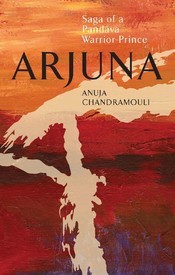
I don't see any significance of the cover design to the story. On the whole, the cover design in woody is texture. And then, there is a tree like design on the front-cover. I don't have any idea, nor the knowledge, of the link between the tree and Mahabharatha. On the contrary, I can't be sure that it is a tree. It could be something else.

Other than that, the cover design is good. Of course, it didn't have any significance as far as the story is concerned. But the look is classy. Ultimately, the cover design is good.

Publishers:
Leadstart Publishing. Lately, I have come across quiet a few books from these publishers. Even Asura by Anand Neelakantan, the book Srinivas - the other almost non-existent author of this blog - is reading, is from Leadstart Publishers. There are few books depicted in the inside of the back-cover of this book. I must say, most of them seem native, deep-in-thought and classy.

Looking forward to read more the books from this publishers.

Language:
The language is one aspect of the book that gives the retold epic an impression of a historical fiction. Meanings of many words expressed in this book are even unknown to me. I only understand the meaning of those words under the pretext of the sentence. It is both a positive and negative point at the same time. Negative because some readers might not decipher the actual meaning of the word and might start hunting for the meaning in the dictionary. Positive because some readers might like those kind of complex words. Also the pretext makes it easy to understand the instant meaning of the word and I didn't find much trouble deciphering their contextual meaning.

Overall, the prose included few unusual words, which you might have not come across before, if you are a vivid reader. If you are vivid reader, you won't be having much trouble with the prose, I assure you.

Story and other aspects:
The book contains typically the story of Mahabharata revolving around the untold hero of the epic, Arjuna. The story of pandavas, especially Arjuna, from the very birth to the moment they all died getting transported to the other side of the world.

The language and prose used makes it sound more of a story than a great Indian epic. It is one reason to keep you going on and help you from the monotony of the story.

When I turned pages to the first page of the story, I was shell-shocked. Right after the page of contents, is the page of Select Cast of Characters. It literally, meant the names and relations of characters from the entire story. The dreadful matter is that it four whole pages! Just imagine, reading a story which has characters of four whole pages! Firstly, it would take a week or two to even memorize the names of those characters. I am sure the very impression is discouraging of a reader to pick up this book. But let me tell you, reader, this aspect is least discouraging. Later, during the time of reading the story, I came to know that the author has tried her hard to make the characters as vivid as possible. This clears any hitches to memorize the names of the characters. And the page of Select Cast of Characters just plays as a guide to refer to the relation of the character during some point of reading the book. Though, I never had a need to refer to that part. Author has well-planned the whole story to such an extent!

I don't know whether Mahabharata has any more story than this, but I am content with this much of story. It is exactly as I have been expecting - witty, touching, historical and magical. Every part of Arjuna's life is explained in such a vivid detail as if the author, herself, has witnessed the happenings and came up with this masterpiece.

I don't this holds much significance, but I couldn't help but notice these couple of coincidences. 

  • The author's first name - Anuja - is so rhyming to the lead character's name Arjuna.
  • From the way she described Arjuna, it clearly evident the author's love for the superhero. Even on the dedication page, she had written, "For Veda Vyasa ~ the finest storyteller this world has ever seen and the who gave me the great love of my life." When she mentioned about the great love of her life, probably, she was referring to Arjuna.
And yeah, Veda Vyasa is indeed the finest story teller ever!

I would like to thank the author for her signature with a lovely message on the dedication page of the book.

Thank you, Anuja...


Overall, the novel was very delighting for me. Every little tale was so well narrated that the reader would want to read the book over and over again in days to come. Once I am done with To Be Reviewed, I would love to re-read this book again. Awesome story. Well told. Very interesting.

Recommendations:
To all those epic lovers and ones who never got a chance to hear Mahabharata from their grand-mothers.

Thank you, Anuja, for being my grand-mother...


Friday, May 24, 2013

The Secret of the Dark by Arka Chakrabarti


Review:
Srishti Publishers have themselves mailed me the copy of this book for reviewing. This is the second consecutive book, I've received for reviewing from this publishers, after The Homing Pigeons.

If you have read my review of The Homing Pigeons, you would have understood in how awe the book had kept me. And this book is no less. In fact, this book is better than the other one. (I don't understand why I keep comparing both the books. Probably, because it was after some time, I have got something substantial to read which caught my interest from start to the end, till the very the page.)


Plot (On the jacket):
Is one born with his destiny or does he forge it?

In the mystical land of Gaya, two prophecies bind the fate of men and empires alike. The Destroyer born from the royal seed on the Land of the Setting Sun shall bring the empires down, or so has been foretold.

In between the Destroyer and the world stand the Seven Guardians of Gaya, guarding the realm of man. A king, a father, defies the Seven and fate itself to save the last drop of his blood and prince Agni grows in the Land of the Rising Sun, exiled from his own people, unaware of his past.

Losing the woman he loved most to the shadows in the dark, Agni is thrown into a whirlpool of events that he neither knows, nor understands. His quest for vengeance brings him to the doorstep of a secret that will shatter the very foundation of beliefs of a world.

Can Agni avert his destiny? Can he uncover the truth about the Seven and the prophecies, now hidden behind a veil of ignorance?

The secrets of the dark are sometimes so terrible that they are better left unsaid.

About the author (On the jacket):
Arka Chakrabarti is a twenty-five year old youngster from Kolkata whose small quest to chalk out the perfect words for the perfect moments drove him to take up content writing not only as a passion but also a profession. A commerce graduate from Heramba Chandra College, he is passionate about reading fantasy novels, ever since he was a child. With this book, he has taken his first step into the world of diction and intrigue, chalking out an unimaginable world of secrets and mysteries.

My take on the book:

Genre:
Fantasy. Frankly, I am very new to this genre of stories. I haven't read many of them, save for the Shiva Trilogy, the story of which I don't actually remember. So there aren't better books to compare this book with. I will try to explain what I felt and how the book is in detail.

Cover design:
I think a little more effort on the design of the cover might have attracted the attention of the readers what the book reserved. Even the tagline - ... the debt of blood is never repaid - on the cover page was blunt and normal. Red text on a dark background wasn't much appealing.

Not to mention, The Homing Pigeons had a very good, or rather pleasant, cover design.

Publishers:
I haven't been a big fan of Srishti Publishers. They have published many boring novels before. But I keep reading books from them because once in a while they come up with gems of the books. For once, take I too had a love story. Even Durjoy Datta was launched by Srishti Publishers. And this month they have launched two gems, again - The Homing Pigeon and The Secret of the Dark.

Apart from the above mentioned points, affordability is another aspect most cultivated by Srishti Publishers. Most of their books cost around hundred bucks or so.

Since this book is pretty thick (340 pages), unlike other books by Srishti and the quality of the story is good, the book has been priced 195.

Story and other aspects:
Being a Fantasy, the author has to explain the details of the setting of the story from the very scratch. The narrating style of the author must be captivating for the reader enough to make him the very realms of the reality. That is what I felt during this read. I started to believe in a world of Gaya, which was divided into two large continents and everything else about the world, mentioned in the story. The fictional map of Gaya, displayed in the starting pages of the book was brilliant. Brilliant is the idea of the map, not the map itself. I think better computerized map would have done a great deal understanding the map. The idea of naming the continents of Gaya as 'The land of setting Sun' and 'The land of rising Sun' was witty.

The aspect of a book I am most keen about is the language. It is the language of the story that creates or shatters the interest of the reader. Readers shouldn't be made to refer dictionary every second page. Neither they should be made to go through a single line more than once. The Secret of the Dark has a very simple language, which would flow as smooth as a hot knife through butter. The writer uses just the correct word to explain the situation, which makes it a pleasant breeze to read this book.

Another best part of this book is its story. Also, story is one reason I rate it four instead of five.

Story is very captivating. The author tried his best to hook the reader to the book by maintaining an unwavering suspense. But at some point of the times, the unending names of the characters gets on the nerve. Add to that, the irritating and confusing Greek-sounding names like Damian, Crixus, Torman, etc. In fact, I couldn't even pronounce a few of them.

There is another story - The story of princess Alexandria - in the book, that runs parallel to the main story. I was waiting for the stories to interject at one point, but that point never came. Also, I don't understand the significance of that story. Maybe, I have missed the part which explained its significance when I was busy racing through the words, trying to break the suspense.

Even at times, the details of the fights got me snoring. Maybe it could be just me, who is bored by the fighting sequences in the novels.

I felt that the end of the story was pretty abrupt. The last one chapter or two was bit of a rush. It was the suspense breaking chapter. There were too much information to relate and understand. The end was pretty sudden. I was left with a feeling - "Is the story over?"

Overall, the story was good. Language was smooth. Plot is interesting. Quiet a good read for this summer.

Recommendations:
I would recommend this book to Fantasy lovers, who are looking for a Action-Fantasy rather than a Romantic-Fantasy.


Title : The Secrets of the Dark

Author : Arka Chakrabarti

Tagline : ...the debt of blood is never repaid

ISBN (edition I've read) : 9789380349909

Publishers : Srishti Publishers

MRP : 195

Pages : 342

Rating : 4 out of 5

Read between : 18-05-2013 to 23-05-2013

Review for : Arup Bose (Srishti Publishers)

Tuesday, January 29, 2013

Animal Farm by George Orwell

Animal Farm by George Orwell

Rating: 3 out of 5

ISBN (edition I've read): 9780141036137

Read between: 27-01-2013 to 29-01-2013

Review:
Note: This book is best if the reader has the fundamental knowledge of the Russian Revolution and Stalin era.

Plot:
Tired of their servitude to man, a group of farm animals revolt and establish their own society, only to be betrayed into worse servitude by their leaders, the pigs, whose slogan becomes: “All animals are equal, but some animals are more equal than others.” Published in 1945, this powerful satire of the Russian Revolution under Stalin remains as vivid and relevant today as it was on its first publication.

My take on the book:
This book is part of the 'ALL-TIME 100 NOVELS'.

I always had a notion to read this book. The name, Animal Farm, was too much for me to resist. I have always been a animal-enthusiast. (Yeah, I pay more heed to the name of the book than the plot. In fact, I had very little idea about the plot of the book.)

The other reason was the thickness of the book. It is damn difficult to resist a well-known classic novel which is seldom 100-pages thick.

There was a fact in the 'A NOTE ON THE TEXT' section of the book. My mother tongue is Telugu and, I learnt from the note, that this one of those few classics which were translated to Telugu. It also states that many versions of this book has been freed of the original subtitle - 'A FAIRY STORY'. The statement goes like this: "Only in Telugu, of all the translations made in Orwell's lifetime, was A Fairy Story retained."

It was only after I came to know that the fundamental knowledge of the Russian Revolution was needed to understand the satire in the novel, I felt disheartened and thought that I should have paid a little attention during my history classes.

To speak of the language, it is the best. No hard words. No undecipherable sentences. Everything was straight-forward. Every was easy to understand. Awesome language, I would like to call it.

Actually, I enjoyed the story even when I know nothing of the Russian Revolution and Stalin era. Though the story was indicating satiric actions equivalents of the happening of a historic event, it was as good as a good fiction novel. Of course, pigs learning to read, talk and dictate over other animals seemed absurd, but it was pretty entertaining. Perhaps, I would have had a better experience of the book, if I had a minimum knowledge of the historic event.

Also there were more than one instance, when I was reading this book and I fell asleep...

Recommendations:
I recommend it to people who have the essential knowledge of the Russian Revolution and Stalin era. I don't know what you would feel during the read.
I also recommend it to those who are in search of a quick, entertaining read.

Sunday, January 13, 2013

Middlesex by Jeffrey Eugenides

Middlesex by Jeffrey Eugenides

Rating: 2.5 out of 5

ISBN (edition I've read): 9780312422158

Read between: 05-01-2013 to 13-01-2013

Review:
It was a thick, 529 pages book. Thick enough to scare the daylight out of me. To top that, it is literature. I knew I was risking so much, but still, reluctantly, I started to rad it. At least, the plot was interesting. It is the first time, I heard changing of sex, as one grows, without them knowing it.

Plot:

"I was born twice: first, as a baby girl, on a remarkably smogless Detroit day of January 1960; and then again, as a teenage boy, in an emergency room near Petoskey, Michigan, in August of 1974. . . My birth certificate lists my name as Calliope Helen Stephanides. My most recent driver's license...records my first name simply as Cal."

So begins the breathtaking story of Calliope Stephanides and three generations of the Greek-American Stephanides family who travel from a tiny village overlooking Mount Olympus in Asia Minor to Prohibition-era Detroit, witnessing its glory days as the Motor City, and the race riots of 1967, before they move out to the tree-lined streets of suburban Grosse Pointe, Michigan. To understand why Calliope is not like other girls, she has to uncover a guilty family secret and the astonishing genetic history that turns Callie into Cal, one of the most audacious and wondrous narrators in contemporary fiction. Lyrical and thrilling, Middlesex is an exhilarating reinvention of the American epic.


My take on the book:

My status updates,

"Almost 30 pages down and I am bored of it. The langugage very complicated and though the font size was considerate, the spacing was enough to scare any reader like me. The lines were like they are glued together. I am foreseeing a 530 pages of hell, ahead. Anyways, it is my bad. I should'be taken my friend's advise and shoud've stayed away from literature."

"Disgusting... I don't know what to comment on brother-sister marriage. Love has no boundaries, I know. But marrying your own sister/brother is, for me, disgusting. It is just my view anyway. I know that it is a never-ending debatable topic."

Page 179 - "The slowest read of my life..."

Page 270 - "One week down and I am only half way through the book. Damn slow and many a times boring..."

The very first chapter of the books takes you on a roller coaster ride synopsis of the book. It high-lights and presents the most interesting bits of the story and when you come to read that part in the later part of the story, it gives a deja vu kind of a feeling.

The whole story is divided into four parts - four books, namely. The most interesting bit of story, for me, was the last part - the fourth book. That is the story dealing with the intersexual protagonist. After reading the first chapter, I was thinking that it is the story of the Cal - the protagonist. But there is background story, dating two generations back.

Just a piece of advise for those who are thinking of reading this book.  Read this book only if you are into literature and contemporary. There is too much comteporary than the story. It isn't the kind of a story which follows the plot, but the story which follows the plot and also describes the life of the people at that period, in that place.

For a reader like me, it is damn boring and when I finally completed - I didn't read the whole book, but scanned the whole of it - I feeling I felt was that of relieve. "Finally, I can start something interesting." (Because I like giving up books in the middle.)

PS: Probably my longest read, yet.......

Friday, January 4, 2013

The Book Thief by Markus Zusak

The Book Thief by Markus Zusak

Rating: 5 out of 5!!!

ISBN (edition I've read): 9781862302914

Read between: 28-12-2012 to 04-01-2013

Review:

Heard a lot of praise about this book. Started reading it with a lot of expectations. And at the end, I was well satisfied. It is probably the last book I started reading last year and the first book I completed this year...

I am certain that you might've heard of the types of narrations - first person and third person. But this book is in a new type of narration. No person narration. The person - or rather, thing - who narrates the story is Death. Yeah, you read it right. It is Death. And the way the author conveyed is much intelligent. The tagline, "When Death tells a story, you really have to listen," can't be more apt...

Plot:
Death has never been busier, and will become busier still. Liesel Meminger's life is changed when, by her brother's graveside, she picks up an object, partially hidden in the snow. It is The Gravedigger's Handbook, left there by accident, and it is her first act of book thievery. So begins a love affair with books and words, as Liesel, with the help of her foster father, learns to read. Soon she is stealing books from Nazi book-burnings, the mayor's wife's library, wherever these books are to be found. But these are dangerous times. When Liesel's foster family hides a Jew in their basement, Liesel's world is both opened up, and closed down.

My take on the book:
I don't think anyone might pick up this book by reading the plot or the description of the book. They - the plot - don't give a minutest hint of what the book has got in store for the reader.
Maybe the 'Death narrating the story' part will attract few curious readers but others who merely depend on descriptions and plots will certainly overlook this book. It is only after watching the online ratings of this book that they realize what great a book they've missed.

After reading 50 or so pages, one would understand that the story doesn't follow a particular plot. No certain rhythm. It is evident that author started writing the story and the story made itself up.

When I sit down and think of writing a review about the book, I don't know what to write. In the case of all other books I've read, there was a certain rhythm in the flow of the story. Then I would high-light few things which I liked and disliked about the book. That is how I write a review. But that isn't helping me in the case of this book. All I could say is,

Go, read the book. You will in no way regret it.

There is no particular reason to hate this book. There isn't for liking this book, for that matter. The book is good. It just is. No reason at all. It is kind of a book which is slow, yet not boring. One couldn't rush through the pages. One couldn't risk missing a single word. It feels like each word of the story is thought for days and got printed.

Recommendations:
Don't expect me to point out a group of people. If you read books, you should read this one.

Sunday, December 9, 2012

Siddhartha by Hermann Hesse

Siddhartha by Hermann Hesse

Rating: 4 out of 5

ISBN(edition I've read): 9780141189574

Review:


About the author:
Hermann Hesse is a German poet, novelist and a painter. He also won Nobel Prize for literature in 1946. Siddhatha is his most acclaimed novel.

"If you hate a person, you hate something in him that is part of yourself. What isn't part of ourselves doesn't disturb us." Is from his novel, Demian. This quote is one reason I like him. It portrays his deep-style of thinking and quantity of knowledge, he possesses, on the human beings.

Plot:
In the shade of a banyan tree, a grizzled ferryman sits listening to the river. Some say he's a sage. He was once a wandering shramana &, briefly, like thousands of others, he followed Gotama the Buddha, enraptured by his sermons. But this man, Siddhartha, wasn't a follower of any but his own soul. Born the son of a Brahmin, Siddhartha was blessed in appearance, intelligence & charisma. In order to find meaning in life, he discarded his promising future for the life of a wandering ascetic. Still, true happiness evaded him. Then a life of pleasure & titillation merely eroded away his spiritual gains until he was just like all the other "child people" dragged around by his desires. Like Hesse's other creations of struggling young men, Siddhartha has a good dose of European angst & stubborn individualism. His final epiphany challenges both the Buddhist & Hindu ideals of enlightenment. Neither a practitioner nor a devotee, neither meditating nor reciting, Siddhartha comes to blend in with the world, resonating with the rhythms of nature, bending the reader's ear down to hear answers from the river.

My take on the book:
I came across this book in a bookstore, which sold old second-hand books. When I first looked at the name of the book and the picture on the cover, I was sure it was about spirituality and the story is of Goutama Buddha.

I read the description on the back of the book and from what I could make out, it was about Siddharatha. There is a terrible misconception in we, people, that Siddhartha is one of the various names of Buddha. Actually, it is not.

I asked many people, whom I came across, "Who is Siddhartha?" Except for few people who pointed towards the actors and other famous persons with that name, most of them said, it is Buddha. At first, even I mistook the name to Buddha and picked up the book thinking it must be his biography or something.

I was awed by the fact that the book is Buddha's biography and is so thin. There were only few pages more than 100. That was another reason I picked up the book.

There were parts of the story which were pretty lame. Not many - if any - kids in India - if anywhere - are so much into spirituality. Kids tend to play. They don't give up their family and friends, to go and live with ascetics, in the forest, to attain nirvana.

But the story which was followed was amazing. After completing the book, I was amazed at how much the thin book held. I felt like enlightened. Not that I know how enlightenment feels. But there was something calm I felt.

Recommendation:
I would recommend to those people who would love and understand spiritual stuff. Not everyone can understand spirituality and ultimately, this book...

Wednesday, December 5, 2012

The Great Gatsby by F. Scott Fitzgerald

The Great Gatsby by F. Scott Fitzgerald
My rating: 3.5 of 5 stars


Reasons, why, I read this book:

* I watched the movie trailer “The Great Gatsby”. I was simply awe with wonder. The trailer is full of life -grandeur, opulent, with lights, parties, music, singing, dancing and sudden spasms of uncontrolled emotions. I thought if a trailer is like that, then, how would be the movie? Most important, how would be the book on which this movie based?

* Because of what I heard - “the book is widely regarded as a "Great American Novel" and a literary classic.”

* The Modern Library named it the second best English-language novel of the 20th Century.

* This book is a part of “Time's List of the 100 Best Novels”.

* Several Goodreads friends of mine immensely liked and highly rated this book.

* I am a little behind in “Goodreads Book Reading Challenge, 2012”. So I am reading only short books and this one has a mere-200 pages.

Beginning Line:

“In my younger and more vulnerable years my father gave me some advice that I've been turning over in my mind ever since.”Whenever you feel like criticizing any one," he told me, "just remember that all the people in this world haven't had the advantages that you've had.”

Read, mind said wow, such an intriguing line, yes, you are absolutely correct, Mr. Fitzgerald. Sometimes we forget this and what we do? Just picture the people in a way we want, attribute the characters we seen not in them, but in our eyes only, not ready to understand them, not ready to give a least shit on them - suppose we do, that is also the way we feel, began to criticize them. We criticize them saying this, that, every bullshit but not ready to accept that he/she is not me and he/she hasn’t had the advantages that we have had. 


The Great Gatsby isn’t great instead it’s a tragic tale, simple but well composed, finely narrated, about Jay “Great” Gatsby, who came from rages into riches, who orchestrated opulent parties, but himself absent in most of them, who loved a single woman till his death, for that he was killed. 


I must appreciate the author. The writing is intense, full of life in detailing the things, describing the scenes with a realistic aura that looks like a painter painted an ordinary hut but with so much precision and passion that it is looking like a villa in a countryside.


The best thing about this book is Nick as a narrator who observed every virtue of the Gatsby. Other characters are empty. The story started and ended very quickly which, might be avoided the unnecessary details, but left the story incomplete. Gatsby is good, but he could have been great only if didn’t choose Daisy. Daisy is a woman with a fiery burning passion. She chooses Tom to marry over Gatsby. But she wants Gatsby’s love. About Tom, I don’t have any specific opinion. Actually I don’t consider him much as a part of the story much either, even Tom was the reason for the tragedy. Tom and Daisy, as Nick said, are simply careless people who do things carelessly for which people like Gatsby are needed to pay, a high price, sometimes with people lives. In the end, what happened between Nick and Jordan, I didn’t understand. 

“Can’t repeat the past?…Why of course you can!”.

This is what Gatsby said. At that moment my reaction was “what fuck he thinks he is doing”. Recently, I just failed in that. But, whole heartily, I wished he could do that; change the Past and make Daisy love him. Is it possible to change the Past? I, myself want to do that; undo the things I did and do the things I didn’t. I know Gatsby is not only the one and will not be the one who tried to repeat the past. But, all these for whom? For the people like Daisy who took the careless decisions for which Gatsby needed to take the blame. When he said that, I am totally afraid of the thought that is Gatsby inspiring me to repeat the past which is almost succeeded in erasing myself out from my own life. In the end, Gatsby failed, no defeated by his love for Daisy, most accurately Daisy herself made Gatsby to be defeated.

Ending Line:

Gatsby believed in the green light, the orgastic future that year by year recedes before us. It eluded us then, but that's no matter - to-morrow we will run faster, stretch out our arms farther ... And one fine morning ---”
“So we beat on, boats against the current, borne back ceaselessly into the past.”

Mr. Fitzgerald again bewildered me with unimpeachable words.  I completed the book. Just sitting there, thinking this phrase only. What I was feeling, didn’t know. I didn’t get the answer why did Daisy leave Gatsby? May be I will never know the answer.

You might also like: